NLP-Driven vs Rule-Based Agents: Trade-Offs 2026

Breadcrumb
What is the real difference between NLP-driven and rule-based agents?
NLP-driven agents interpret human language with statistical or language-based models, while rule-based agents follow predefined logic such as decision trees, keywords, and if-then flows. That difference shapes everything from setup time to maintenance, accuracy, and user experience. If you want the wider foundation first, what are NLP-driven AI agents and how they work explains the mechanics behind language understanding in more detail.
In practice, rule-based systems are strongest when the task is narrow, predictable, and highly controlled. Think password reset flows, order-status checks, or internal routing questions with a limited range of valid answers. They are easier to audit and often quicker to approve in regulated environments because every path is explicit.
NLP-driven agents shine when people ask messy, varied, conversational questions. They can map different phrasings to similar intent, handle partial context, and create a more natural interaction. That matters in customer support, self-service portals, and internal knowledge tools where users rarely follow a script.
The trade-off is straightforward:
- Rule-based agents offer more control and predictability
- NLP-driven agents offer more flexibility and coverage
- Rule-based systems usually cost less to start
- NLP-driven systems often reduce friction at scale
- Governance is simpler with rules, but broader automation is often stronger with NLP
Choosing between them is less about which is “better” and more about how much language variability, business risk, and operational complexity your use case can tolerate.
When do rule-based agents outperform NLP-driven agents?
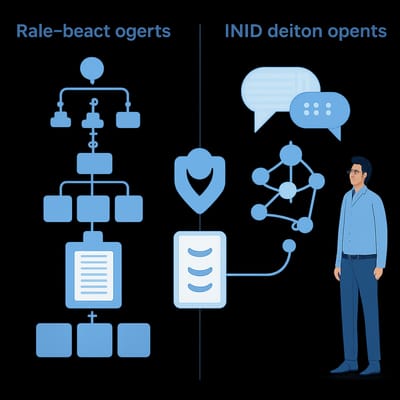
Rule-based agents outperform NLP-driven agents when your process depends on consistency, compliance, and a tightly bounded input set. If the goal is to guide users through a fixed workflow, rules are often the better fit. They work especially well for transactional interactions where the wrong answer is worse than a limited answer.
Common examples include:
- Appointment scheduling with fixed options
- Policy or eligibility triage using clear criteria
- Internal IT service desk routing
- FAQ flows with stable wording and low variation
- Lead qualification forms with defined decision branches
For IT professionals, this can mean faster deployment into existing service management environments, with simpler logging and escalation rules. For product managers, rule-based agents are often useful in early-stage rollouts because they make behavior easier to predict, measure, and refine before broader automation is introduced.
Another advantage is governance. A rule-based system lets you inspect why a response happened because the decision path is visible. That is helpful when legal review, customer experience standards, or operational approvals are strict. Cost can also be lower at the beginning because there is less model tuning, less data preparation, and fewer edge-case interpretation issues.
The downside appears as soon as users go off-script. Coverage gaps grow quickly when language becomes more natural, and maintaining a large rule library can become tedious. A simple flow stays simple. A complex flow often turns fragile.
Where do NLP-driven agents create more value?
NLP-driven agents create more value when users ask open-ended questions, use inconsistent wording, or expect a conversation that feels natural rather than menu-driven. These agents are useful when your business needs intent recognition, language variation handling, and broader self-service coverage across many topics.
Typical use cases include:
- Customer support across large knowledge bases
- Sales and service chat experiences
- Internal knowledge assistants for teams
- Document and message classification
- Multistep workflows triggered from natural-language requests
For SMB marketing teams, this can be especially valuable in lead capture and campaign support. A prospect may ask about pricing, integrations, onboarding time, or industry fit in many different ways. An NLP-driven agent can absorb that variation better than a rigid keyword flow. For business buyers, the value often shows up as lower support volume, better routing, and more useful user interactions.
NLP-driven systems also help when your organisation needs to learn from real conversations. Patterns in failed intents, escalation reasons, and user phrasing can reveal where knowledge gaps or process issues exist. That creates useful input for topics like performance measurement, future chat bot design, and broader customer support automation.
Still, more flexibility introduces more responsibility. You need testing, guardrails, fallback handling, and monitoring. Without strong governance, an NLP-driven agent may answer confidently but inconsistently. The upside is scale and usability. The cost is more operational discipline.
How should you compare cost, control, and ROI?
A useful comparison starts with three questions: how variable are user inputs, how risky is a wrong answer, and how often will the process change? Those answers usually tell you whether ROI will come faster from a rules engine or from an NLP layer.
| Factor | Rule-based agents | NLP-driven agents |
|---|---|---|
| Upfront setup | Usually lower for simple flows | Higher due to design, training, and testing |
| Ongoing maintenance | Can rise sharply with complexity | Requires monitoring and tuning |
| Response control | High | Medium to high with guardrails |
| Handling language variation | Low | High |
| Best for | Narrow, stable workflows | Broad, conversational tasks |
| ROI pattern | Quick wins in limited use cases | Larger gains when volume and variation are high |
For product managers, this means scoping the smallest useful deployment first. For IT professionals, it means evaluating integration costs, auditability, and failure modes. For SMB marketing teams, the commercial lens is simpler: will the agent reduce drop-off, capture more qualified leads, or shorten response time enough to justify operating cost?
A hybrid approach is often the most practical. Rules can manage permissions, routing, and hard constraints, while NLP handles natural-language understanding at the front end. That model balances control with usability and often improves adoption. If your team is comparing future builds, topics like agent evaluation metrics, vendor review, and implementation roadmaps deserve a deeper look before rollout.
What trade-offs matter most before you choose an agent type?
Before choosing an agent type, focus on the trade-offs that affect performance in the real world, not just in demos. The most important ones are accuracy under messy input, governance, implementation speed, and scalability.
Here is a practical way to think about it:
Choose rule-based first if:
- Your workflow is tightly defined
- Answers must stay within approved paths
- Teams need strong auditability
- You want a faster, lower-risk launch
Choose NLP-driven first if:
- Users ask questions in many different ways
- You need broader self-service coverage
- Conversation quality affects conversion or satisfaction
- The business can support ongoing optimisation
There is also a human factor. Rule-based agents can feel rigid but dependable. NLP-driven agents can feel helpful and efficient, yet they require trust-building through testing and clear fallback behaviour. In customer-facing settings, a graceful handoff often matters as much as the answer itself.
If you are building toward a larger automation roadmap, keep the decision reversible. Start with one high-value use case, define success metrics, and document where users fall outside the expected flow. That gives non-brand developers a clearer architecture path and gives business buyers a better basis for ROI conversations, case study reviews, and product demo requests. It also makes newsletter, whitepaper, or case-study follow-up feel useful instead of premature because the decision is tied to measurable outcomes.
FAQ: NLP-driven vs rule-based agents
What is the main difference between NLP-driven and rule-based agents?
NLP-driven agents interpret natural language and can handle varied phrasing, while rule-based agents follow fixed logic paths. The best option depends on how predictable your user inputs and workflows are.
Are rule-based agents still useful for modern automation?
Yes. They are often the best fit for narrow, repeatable processes such as routing, eligibility checks, and simple support flows. Their predictability makes them valuable in regulated or high-control environments.
Which option is better for SMB marketing teams?
SMB marketing teams often benefit from NLP-driven agents when leads ask open-ended questions across chat, forms, or support channels. If the interaction is limited to a few fixed qualification steps, a rule-based agent may be enough.
How should product managers evaluate agent trade-offs?
Product managers should compare task complexity, user language variation, error tolerance, and maintenance effort. It also helps to define success metrics early, such as containment rate, escalation rate, or conversion impact.
What should IT professionals look for before deployment?
IT professionals should assess integration requirements, logging, fallback controls, access permissions, and auditability. They should also review how the system handles errors, escalations, and policy-sensitive responses.
Do NLP-driven agents always cost more?
Not always over the full lifecycle, but they often require more upfront work for testing, tuning, and governance. In high-volume conversational use cases, they can deliver stronger long-term ROI by improving coverage and reducing manual handling.
Is a hybrid model better than choosing one approach only?
Often, yes. Many teams use NLP for language understanding and rule-based logic for approvals, routing, and constrained actions. This approach can balance flexibility with control.
What are the best use cases for starting small?
Good starting points include customer support triage, internal help desk requests, lead qualification, and document routing. These use cases are easier to measure and make it simpler to compare costs, accuracy, and business value.