Breadcrumb
Latest Articles


What are AI agents and why do they matter now?
AI agents are software systems that can interpret inputs, make decisions within defined limits, and take action to achieve a goal. In practical terms, that might mean answering a support question, retrieving information, updating a record, routing a request, or triggering a workflow across connected tools. Their value comes from combining language, logic, and action rather than stopping at simple output generation.
That is why AI agents now sit at the center of many conversations about automation and conversational AI. Businesses are no longer asking only whether AI can produce text. They want to know whether it can reduce support load, improve service speed, help teams work more efficiently, and produce measurable return. For developers, that means thinking about pipelines, integrations, orchestration, and monitoring. For business buyers, it means separating useful systems from impressive demos.
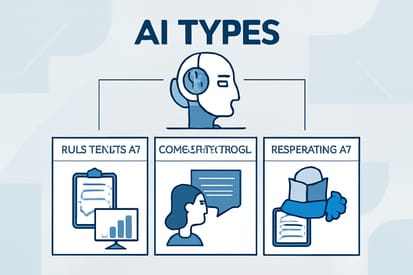
The topic is broad, so it helps to navigate it by category. A strong starting point is aI Types, which gives a wider view of the main system categories, capabilities, and deployment choices that shape real-world adoption.
Different teams approach AI agents with different goals. An SMB marketing team may want better lead handling or campaign support. A product manager may focus on in-app assistance and user onboarding. An IT professional will usually care most about security, auditability, and reliable integration. A good cornerstone page should help all of those readers understand the landscape before they move into more specific comparisons and implementation questions.
How do AI agents differ by type and capability?
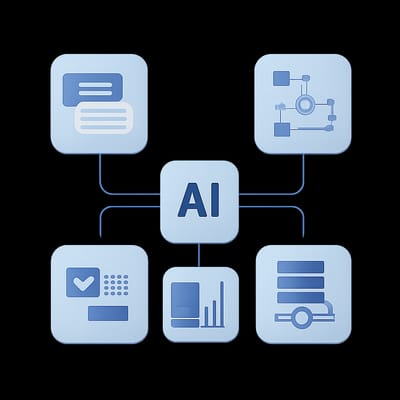
Not all AI agents work the same way. Some are built for natural-language interaction, some for deterministic workflows, and others for broader machine-led decision support. Understanding the differences is essential if you want to choose the right architecture and avoid mismatched expectations.
Common ways AI agents differ
- Language handling: Some agents specialize in interpreting natural language, while others rely on structured inputs.
- Decision style: Some follow fixed rules, while others use more adaptive models.
- Action scope: Some only answer questions, while others trigger processes across systems.
- Context depth: Some respond turn by turn, while others maintain richer task or user context.
- Governance needs: More adaptive systems often require stronger oversight and testing.
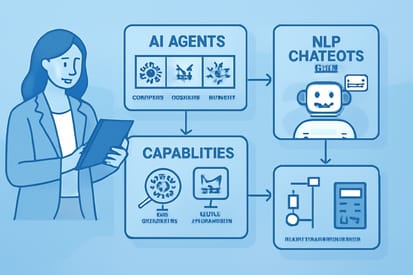
One of the most useful distinctions is between NLP-driven agents, ML-powered chat bots, and rule-based agents. NLP-driven systems are often better at handling flexible language. Rule-based agents are often easier to control in narrow workflows. ML-powered systems may extend into personalization, prediction, and prioritization. In practice, many effective deployments blend these approaches rather than choosing only one.
If you want a broader map of how these categories relate, aI Types provides a useful foundation. From there, it becomes easier to explore narrower topics such as NLP-driven agents, trade-offs between rule-based and more adaptive systems, and how specific capabilities support customer support, data processing, or internal operations.
Which AI agent use cases create the strongest value?
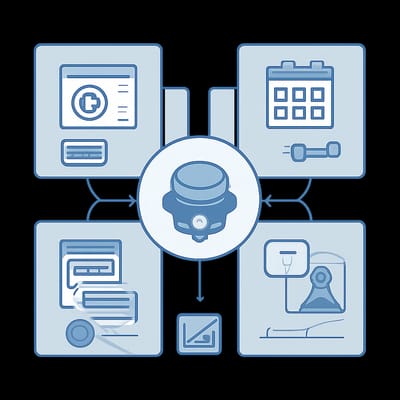
The strongest AI agent use cases usually combine high request volume, repeatable intent patterns, and clear operational metrics. When those conditions are present, agents can reduce friction, speed up response times, and free human teams for more valuable work.
Common high-impact use cases
- Customer support through triage, self-service, and case routing
- Internal operations such as IT help desks, HR queries, and documentation support
- Data processing including extraction, classification, retrieval, and summarization
- Sales and marketing workflows such as lead handling and campaign support
- Product assistance through onboarding, in-app guidance, and feature discovery
Value varies by audience. SMB marketing teams often benefit from faster lead qualification and campaign support workflows. Product managers may use AI agents to reduce friction in onboarding or help users find the right features. IT professionals often focus on internal service efficiency, permission-aware support, and operational resilience.
The reason these use cases matter is that they connect directly to ROI. You can measure changes in average handling time, resolution speed, deflection, manual effort, or user satisfaction. That makes adoption more disciplined and less speculative.
As organizations mature, they often move from a single use case into broader orchestration. That progression raises more specific questions about customer support patterns, data processing scenarios, and performance metrics, all of which deserve focused treatment once the business case is established.
What architectures, governance, and controls matter most?
A successful AI agent deployment depends as much on architecture and governance as on model quality. Even a capable system can fail if it cannot access the right data, enforce permissions, or hand off safely when confidence is low.
Core architecture and governance priorities
- System integration with CRMs, ticketing platforms, knowledge bases, and internal tools
- Access control so users and agents only reach approved data and actions
- Auditability for tracking responses, decisions, and workflow execution
- Fallback logic for low-confidence answers and exception handling
- Monitoring for failures, weak intents, latency, and policy risks
- Compliance alignment for regulated, customer-facing, or security-sensitive use cases
These issues are often where real deployments succeed or fail. A product manager may care about how an agent fits into the user journey, but an IT team has to ensure it operates safely and predictably. Developers need to think about orchestration, testing, and long-term maintainability. Business buyers, meanwhile, need confidence that rollout risk is manageable and outcomes are measurable.
This is especially important in markets where procurement, compliance, and operational trust shape adoption speed. Whitepapers, demos, and case studies can be useful here, but only if they show practical controls and measurable outcomes rather than generic claims.
As you evaluate options, think of governance as part of product quality, not as a separate checklist. Reliable AI agents are built, tested, and measured as operational systems, not just conversational interfaces.
How do you evaluate cost, ROI, and implementation readiness?
Evaluating AI agent ROI starts with defining one workflow and measuring it clearly. Without a baseline, even the most polished solution can look better than it really is. Cost, value, and readiness should all be reviewed together.
Questions that improve evaluation
- What repetitive task or bottleneck are you targeting?
- How much human time does it consume today?
- What systems must the agent integrate with?
- What happens when the agent cannot complete the task?
- Which metrics will prove success after launch?
Common cost areas
- Setup and integration work
- Platform or model usage fees
- Content and workflow design
- Ongoing tuning and monitoring
- Human review, escalation, and maintenance
ROI often becomes visible through faster response times, lower support volume, improved self-service, reduced manual processing, or better lead handling speed. Product managers may also look at activation, retention, or in-product support deflection. SMB marketing teams might measure how quickly inbound opportunities are qualified. IT professionals may track time saved on repetitive internal requests and incident routing.
A sensible adoption path usually begins with a pilot, not a full-scale rollout. That allows teams to test one use case, request a product demo, review case studies, and decide whether a wider deployment is justified. If you are still comparing broader categories before that stage, aI Types offers a practical route into the next level of evaluation.
Where should you go next as you explore AI agents?
The smartest next step depends on how far along you are. If you are still mapping the landscape, focus first on categories, capabilities, and major trade-offs. If you already have a use case in mind, start narrowing the field by workflow fit, governance requirements, and measurable outcomes.
For many readers, the best continuation is aI Types, because it organizes the broader category before you dive into specific agent models or deployment decisions. Once that foundation is clear, more focused topics become much more useful. That includes understanding what NLP-driven AI agents are and how they work, comparing NLP-driven and rule-based approaches, exploring how chat bots are built with NLP pipelines, reviewing top use cases in customer support and data processing, and evaluating performance metrics for AI agents.
This layered approach is more practical than trying to solve everything at once. Developers can move from architecture questions to implementation patterns. Business buyers can move from category understanding to ROI evaluation. Product managers can focus on user experience and adoption. IT professionals can assess operational controls and deployment readiness.
If you are ready to act, choose one workflow, define success metrics, and gather the evidence you need. A newsletter can help you track changes in the space, a whitepaper can sharpen governance thinking, a demo can test product fit, and case studies can show whether similar organizations have achieved meaningful results.
FAQ about AI agents
What is an AI agent in simple terms?
An AI agent is a software system that can interpret input, decide what to do within defined rules or models, and take action. It goes beyond simple response generation by connecting understanding with workflows or decisions.
How are AI agents different from chat bots?
Some chat bots only handle conversation, while AI agents often include an action layer that can retrieve data, trigger workflows, or complete parts of a task. In practice, some tools combine both roles.
Are AI agents useful for SMB marketing teams?
Yes, especially for tasks like lead qualification, campaign support, and handling repetitive inbound questions. The strongest results usually come from focused workflows with clear response and conversion goals.
What should product managers evaluate first?
Product managers should look at workflow fit, user experience impact, handoff quality, and measurable outcomes such as reduced support burden or improved onboarding. The agent should support the product journey rather than interrupt it.
What matters most to IT professionals during deployment?
Security, access controls, logging, auditability, integration reliability, and fallback behavior are usually the biggest concerns. These factors determine whether an AI agent can operate safely in production.
Can AI agents combine NLP, rules, and machine learning?
Yes. Many effective agents use NLP for language understanding, rules for control and permissions, and machine learning for ranking, prediction, or prioritization. Hybrid designs are common in production environments.
How do you measure ROI for AI agents?
Use before-and-after workflow metrics such as average handling time, support deflection, resolution accuracy, manual hours saved, or lead response speed. ROI is clearest when tied to a specific use case and baseline.
When should a team move from research to a demo or pilot?
Usually after narrowing the use case, defining governance needs, and setting success metrics. A demo or pilot is most valuable when tested against a real workflow rather than general curiosity.