AI Agents & NLP Chat Bots: Types Guide 2026
Breadcrumb
What are AI agents and NLP chat bots?
AI agents are software systems that interpret inputs, make decisions, and take actions toward a defined goal. NLP chat bots are a major subset built to understand human language, respond conversationally, and often connect those conversations to business workflows. Some tools stay narrowly focused on answering questions, while others retrieve information, route tasks, update systems, and support more complex automation.
That distinction matters because many teams use the terms interchangeably. A chat bot may simply present a conversational interface, but an AI agent usually goes further by combining language understanding with logic, memory, tools, and automation. For developers, that affects architecture and observability. For business buyers, it changes how you assess value, risk, and long-term fit.
This topic is especially important for organizations evaluating support automation, internal knowledge access, lead handling, or operational workflows. A product manager might view an agent as a way to reduce friction in user journeys. An IT professional may focus more on integration boundaries, permissions, and audit trails. In a smaller business, a marketing team may care most about qualifying inbound requests and organizing campaign responses.
If you want a deeper foundation on the core concept, what are NLP-driven AI agents and how they work explains the mechanics in more detail. This page gives you the broader landscape, including types, capabilities, implementation patterns, and how UK-based teams can evaluate rollout options with more confidence.
What types of AI agents should you compare first?
Most teams do better when they start with clear categories instead of shopping by feature list. The most practical comparison is between rule-based agents, NLP-driven agents, and broader ML-powered systems.
- Rule-based agents follow predefined logic and decision trees.
- NLP-driven agents interpret user language and act on intent, context, and retrieved information.
- ML-powered systems use learned patterns for prediction, ranking, personalization, or classification, sometimes with little or no conversation involved.
A rule-based system can be the right choice when your workflow is fixed, highly predictable, and tightly governed. NLP-driven agents are stronger when requests vary in wording and users expect more natural interaction. ML-powered systems add value when the priority is forecasting, scoring, or pattern detection rather than dialogue.
In practice, many production systems blend these approaches. An agent may use NLP to understand a request, rule logic to enforce policy, and machine learning to rank answers or detect anomalies. That is often where real performance comes from.
The trade-offs become easier to see in nLP-driven vs rule-based agents: use cases and trade-offs. It is particularly useful if you are deciding whether flexibility is worth the extra tuning, monitoring, and governance. For most business teams, the right answer depends less on hype and more on input variability, operational risk, and the cost of mistakes.
What capabilities do NLP-driven agents bring to business teams?
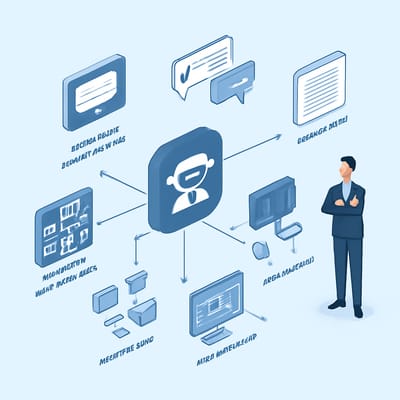
The most useful NLP-driven AI agents do more than answer prompts. They connect language understanding to action. That means they can interpret a request, pull context from a knowledge source or business system, and then decide what to do next. In a support environment, that may mean resolving a common issue automatically or escalating the case with a clean summary.
Common capabilities include:
- Intent detection for varied user questions
- Entity extraction from emails, forms, or chat messages
- Knowledge retrieval across documents, FAQs, and internal systems
- Workflow orchestration such as ticket routing or CRM updates
- Summarization and handoff for human review
- Context retention across multi-step conversations
These capabilities matter differently depending on the team. SMB marketing teams may use conversational automation to qualify leads, tag free-text survey responses, or route high-intent inquiries faster. Product managers often care about surfacing patterns in customer feedback and reducing friction in onboarding or support journeys. IT professionals typically focus on service desk automation, knowledge management, and access control workflows.
You can think of capability mapping as the bridge between a demo and a deployment. It helps you identify whether the agent needs retrieval, memory, approval steps, multilingual support, or tight governance. Related topics like top use cases for AI agents in customer support and data processing deserve deeper treatment because the strongest implementations are usually tied to one clear operational outcome.
How do chat bot architectures and NLP pipelines fit together?
Architecture is where good ideas either become reliable systems or stall out in pilot mode. A conversational interface alone is not enough. Behind the scenes, most strong deployments combine several layers: input handling, language understanding, retrieval, business logic, action routing, and monitoring.
A common architecture pattern looks like this:
- User input layer captures chat, voice, email, or form text.
- NLP layer detects intent, entities, tone, and context.
- Retrieval layer brings in relevant policies, product data, or historical records.
- Decision layer applies rules, thresholds, and workflow logic.
- Execution layer responds, updates systems, or escalates to a human.
- Monitoring layer logs performance, failure points, and compliance events.
This matters because implementation quality often depends more on orchestration than on the model itself. A product manager may need confidence that handoffs are smooth. An IT leader will care about permissions, observability, and fallback behavior. Developers usually spend most of their time on integration and testing, not on the user interface.
For a more technical walkthrough, how to build a chat bot using NLP pipelines breaks down how these components work together. Even if you are buying rather than building, understanding the pipeline helps you ask better vendor questions and spot weak architecture before it creates operational issues.
How should you evaluate governance, cost, and ROI?
The best AI agent decisions usually come from evaluation discipline, not feature excitement. Before adopting any platform or building internally, define the problem, success metrics, and acceptable risk boundaries. That sounds basic, but it is often the difference between a productive pilot and a stalled project.
Start with five evaluation areas:
| Area | Key question |
|---|---|
| Business fit | What specific workflow or outcome are you improving? |
| Data readiness | Are your knowledge sources accurate, current, and accessible? |
| Governance | What needs approval, escalation, logging, or restriction? |
| Cost model | What will setup, usage, maintenance, and oversight cost? |
| ROI | How will you measure time saved, containment, quality, or revenue impact? |
For business buyers, this is where cost and ROI become concrete. A team may reduce support load, shorten response times, improve consistency, or surface revenue opportunities that were previously missed. Developers need a different lens, including evaluation datasets, traceability, failure analysis, and observability. IT teams often prioritize policy enforcement and system security first.
A fuller review of evaluating performance metrics for AI agents is worth doing before expansion, especially if leadership expects hard evidence. If you want a more structured next step, downloading a whitepaper, viewing case studies, or requesting a product demo can help turn early interest into a usable shortlist. The strongest business cases are measurable, narrow at first, and grounded in one clear workflow.
What does UK implementation look like in practice?
UK implementation is less about geography alone and more about operating context. Teams often need to account for procurement processes, internal governance expectations, data handling rules, and the practical question of whether to build, buy, or work with an outside specialist. That is why rollout planning should include not just features, but ownership, escalation design, and support resources.
A realistic implementation roadmap usually follows this order:
- define one narrow use case with measurable outcomes
- identify data sources and system integrations
- set confidence thresholds and human handoff rules
- pilot with a limited audience or workflow
- review logs, user feedback, and operational impact
- expand only after governance and ROI are clear
For some organizations, internal teams can handle this well. Others benefit from outside support when requirements are complex, timelines are tight, or internal expertise is still developing. That can be especially relevant for UK-based businesses balancing delivery speed with governance expectations.
When deciding whether to involve an AI agency, focus on practical gaps: integration capability, domain expertise, compliance confidence, and the ability to move from pilot to production. Case studies help here because they show where value appeared first and what the rollout actually required. If you are early in the process, a newsletter can keep your team informed, while a demo or consultation is more useful once you have a clear use case and success metric in mind.
Frequently asked questions about AI agents and NLP chat bots
What is the difference between an AI agent and an NLP chat bot?
An AI agent is a broader system that can interpret inputs, make decisions, and trigger actions. An NLP chat bot is usually a conversational interface that uses language understanding, and in advanced cases it can function as one part of a larger agent system.
When should a business use rule-based automation instead of an NLP-driven agent?
Rule-based automation is often better when the workflow is fixed, highly predictable, and requires tight control. NLP-driven agents are more useful when users ask for the same thing in many different ways and context matters.
Are AI agents useful for SMB marketing teams?
Yes. They can help with lead qualification, routing inbound conversations, tagging free-text responses, and handling repetitive campaign questions. Starting with one measurable use case is usually the best way to prove value.
How can product managers assess whether an AI agent improves the user experience?
Product managers should track completion rates, fallback frequency, escalation quality, user satisfaction, and downstream outcomes such as faster onboarding or fewer support delays. Reviewing real interaction logs also helps reveal where journeys break down.
What should IT professionals evaluate before approving deployment?
IT teams should assess identity controls, data access, logging, monitoring, integration limits, and failure handling. Security and governance often determine whether a promising pilot can safely move into production.
Do UK businesses need a different implementation approach?
Often, yes in practical terms. UK teams may need to align more closely with internal governance, procurement, and stakeholder review processes, so phased rollout and documentation become especially important.
How do you measure ROI for AI agents and chat bots?
ROI usually comes from time savings, lower handling costs, faster response, improved consistency, and better conversion or service outcomes. A clear baseline before launch makes those gains much easier to prove.
When should you choose an external AI agency or vendor?
Outside support makes sense when your team needs faster delivery, stronger integration experience, or help with governance and production rollout. It is usually most valuable once you have already defined the use case, success metric, and operational constraints.